Wednesday, February 29, 2012

The Delights of Mrs. Pym

I was predisposed to like this book, as the heroine bears the same surname as one of favorite detecting females, Josephine Tey's delightful Lucy Pym of Miss Pym Disposes.  


Then I opened the cover and found this:


I'm always delighted to find traces of prior ownership in a book.  I like to think that Dorothy was pleased to own this book and that, given the date of 1943, it brought some much needed relief from the depressing news of the time.  Her handwriting is the old-fashioned sort of handwriting that I was taught in grade school but lost during law school as speed was more of necessity than quality.  Her signature reminds me of a time when handwriting was considered an art form.

And then I turned the page and found this dedication:


I'd love to know the story behind that.

Before I'd read a word, I was utterly beguiled by this book.  And I'm pleased to say that the rest of the book lived up to my expectations.  It's a pity that the Mrs. Pym series is so difficult to find.


Monday, February 27, 2012

Sunday, February 26, 2012

Be Still My Heart

I was sure that no one would ever replace Jonny Wilkinson as my favorite rugby player of all time.  Not only was Jonny a world class player, he was quiet, unassuming, hard working, and a very handsome fellow.  I was devastated when he retired from international competition.


But then along came this youngster, 20-year old Owen Farrell, playing in Jonny's old position as the English national team's fly-half and widely touted as "the next Jonny Wilkinson."  If it were anyone else, that phrase would set my teeth on edge but after watching Owen play, I concede that he may be the real deal.  He'll never knock Jonny off his pedestal, but he may join him there.


Thursday, February 23, 2012

Why Sales Figures Matter

There's an interesting article in the NY Times today regarding Patricia O'Brien, the author of five previous books.  Her agent submitted her sixth, a novel, to 13 publishers and found no takers.  The reason?  O'Brien's last novel had sold only 4,000 copies.  Book sales information is available to publishers who subscribe to Nielsen BookScan, a service which tracks approximately 75% of retail sales of printed books.  It does not include ebooks.

At the suggestion of her agent, O'Brien adopted a pseudonym and her agent pitched the novel to more publishers.  It sold in three days to Doubleday, part of Random House.  O'Brien's agent said, "I realized the book was not being judged on its merits.  It was being judged on how many books she sold."

Other interesting quotes from the article:

Referring to BookScan, the reporter states that "many authors" consider the service a "modern publishing scourge."

"...publishers are being unusually cautious about which books they can invest in and how much they can pay in advances."

I can see that publishers would be wary of signing an author whose last book did not sell well.  On the other hand, should that be the reason for turning down a completely different book?  A different book which was apparently so compelling it was snapped up by a major publisher in three days?  To be fair, the reporter should have stressed just what kinds of costs publishers incur when signing an author.  And it is a business, after all, and one can only rely upon the indicators which are available to you about the commercial viability of the product when you make a decision to purchase it.

The upshot of the article is that authors will now struggle to stay published if they don't meet publishers' expectations about sales figures, regardless of the quality of their new submission.  I expect this issue will become more important to authors as publishers struggle to ward off the rise of Amazon.  I feel queasy just thinking about it.  You can read the article here.

Wednesday, February 22, 2012

Speaking of Public Speaking

I'm teaming up with my agent, Ann Collette of the Rees Literary Agency, and conducting a breakout session on the author/agent relationship at the 2012 Missouri Writers Guild conference which will be held in St. Louis on April 20-22.  I'm pretty sure I'll be sitting there quietly while Ann is besieged with questions about how to get an agent, but it should be fun anyway.  Since Ann lives in Boston, we'll be meeting face-to-face for the first time.  She's a terrific lady with a wicked sense of humor and I have no doubt I'll be laughing a lot that weekend.  Here's what we'll be discussing.

Tuesday, February 21, 2012

To Finish or Not to Finish

That is the question.  If I start a book and find I don't like it or am not in the mood to read it, I usually make the decision to quit reading by p. 50 or so.  But right now I'm almost 300 pages into a book with 150 pages left, and I'm ready to take out my bookmark and move on.  There's nothing wrong with the book.  It's a cracker.  Sarah Helm has written a fascinating biography of Vera Atkins, a powerful figure in Britain's Special Operations Executive, which was responsible for gathering intelligence and sabotaging targets in Nazi-occupied Europe.  Atkins's job was to recruit and dispatch men and women to France to act as organizers, couriers and radio operators.  After the war ended, she searched relentlessly to learn the fates of the one hundred SOE agents who had disappeared in France.  The number included sixteen women.

My difficulty with the book is simply that the story is so relentlessly oppressive that I'm beginning to buckle under the weight.  I've read a great deal about espionage activity in WWII and the treatment of prisoners by the Gestapo, but Helm tells a story that is horrifying because so many prisoners were caught and died due to bureaucratic incompetence and callous negligence.  Then there's the whole issue of how women agents were treated.  They were rather cavalierly sent off to France with the understanding that they'd never break cover if they were caught, their disguise as simple French girls would persuade the Germans they were harmless, and because they were women the Gestapo would treat them humanely.  It turned out to be rather difficult to maintain the fiction that you have nothing to do with the French resistance movement when you're caught red-handed with a radio set in your bedroom and your finger poised on the transmission key.

Nor were women granted military commissions as were the men.  SOE executives thought a military rank would ensure that male prisoners would be treated in accordance with the Geneva Convention.  Of course they were as wrong about this as they were about the Gestapo's chivalrous attitude to women.  The women also left England without a guarantee of pension benefits to surviving family, unlike the men who were entitled to such as military officers.

I'm also incensed at the complete ineptitude and dogged stupidity of the people at SOE HQ in London. If a radio operator was captured, the Germans immediately pressured him or her to transmit false reports.  SOE was aware this might happen and required each agent to submit a security check in their reports.  The security check took various forms:  a word, a phrase, a number, a misspelled word and so on.  After a little softening up, many agents did transmit, but without their security check to tip off HQ that they had been nabbed.  What did HQ do?  Admonished the agent in the next message to please include their security check next time.  Predictably, the Gestapo interrogators got busy finding out their prisoners' security checks.  As a backup, a false check was also provided.  If it appeared in the message, it was another tip-off to HQ.  The SOE folks back at the office sent back messages along the lines of, "Really, old chap, you mustn't include your false check in your messages as we'll think you've been captured."  This went on and on and on for a full year, while more and more agents were parachuted into France to a reception committee organized by the Germans.

This sort of willful ignorance continued after the war, with little effort expended to located captured agents.  Vera Atkins essentially conducted a one-woman campaign to track down the missing operators.  SOE and the military were reluctant to circulate pictures and names to the Russians and American who were busy liberating concentration camps for fear of revealing the identities of the agents.  The Brits just assumed that these shattered survivors of torture would take a few weeks at a seaside resort and then be willing to take on the communists.  My blood boils at the official indifference to the plight of these men and women.
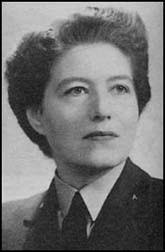
And then there's Vera.  I'd love for her to be the unblemished heroine, but alas, she is not.  Interviews with her comrades after the war indicate a range of feelings about her that range from "strongly dislike" to "pure hatred."  She was efficient, ruthless, fiercely loyal to her boss and her agents, but a complete mystery to most people.  She revealed nothing of herself to anyone with whom she worked, which is understandable as she was actually a Romanian Jew whose last name was Rosenberg.  She was not naturalized as a British citizen until 1944, which meant that she was a foreign national from a country run by fascists under Nazi direction while she worked in one of the most sensitive areas of the British war effort.  Her story is not a happy one, and her post-war career is a tale of a lonely woman who was eventually accused of being a Soviet spy.

Between the SOE blunders, Vera's antagonistic personality, and the disparity in the treatment of the female agents, I am reading this book with an ever increasing feeling of gloom.  There's no happy ending here, just a brutal record of incompetence, arrogance, stupidity and sadism.   I though that writing this post might help me clarify my own feelings about the book.  It's an important book.  It's well-written and meticulously researched.  But it is bleak.  Well, I'm still on the fence.  I think I'll set it aside for awhile and find something more uplifting.

I've got this bio of Vera Atkins in my TBR file.  Do I dare?


Monday, February 20, 2012

Who Killed the Curate?


WHO KILLED THE CURATE?  Joan Coggin (1944)


Who Killed the Curate? introduces Lady Lupin Lorrimer Hastings, the beautiful, dutiful new wife of Andrew Hastings, vicar of St. Mark’s in the tiny town of Glanville.  Lady Lupin tries her best but she really isn’t cut out to be a vicar’s wife, having only a nodding acquaintance with affairs ecclesiastical.  As she puts it, she’s still struggling to distinguish the Jews from the Jesuits.  When she joins Andrew’s flock the formidable ladies of the town, and there are several, set their sights on her, intent upon securing Lady Lupin as the prize recruit for their various organizations.  What should Lady Lupin do?  Should she head up the Temperance Society?  The Mothers’ Union?  The Girl Guides?  The Sunday School?  The competition is fierce.  The only thing the women of Glanville can agree upon is their dislike of the unpopular curate, Mr. Young.  When he’s murdered, Lady Lupin and friends set out to solve the crime.

 Alright, let’s just get this out of the way at the beginning:  there’s absolutely no detection in this detective novel.  Everything is left for the big reveal at the end, in which a parishioner’s secret returns to haunt him/her, but you would never have guessed who or what or why because there just aren’t any clues.  HOWEVER, I’m going to read the other three books featuring Lady Lupin.  I’m willing to forego the absence of an adequate amateur detective (and any actual detection) because the book was a brilliant depiction of small town life and the jockeying for eminence among the inhabitants.  The dialogue is hilarious.  I cannot resist a book that makes me laugh out loud.  And at 157 pages (in the Rue Morgue Press edition), it’s not like you’re investing much time.  You’ll be smiling when you put down this book, as long as you start reading with the understanding that detection is not its strong suit.

Joan Coggin's Who Killed the Curate is one of my entries in the Golden Age Girls category of Bev's Vintage Mystery Challenge.